
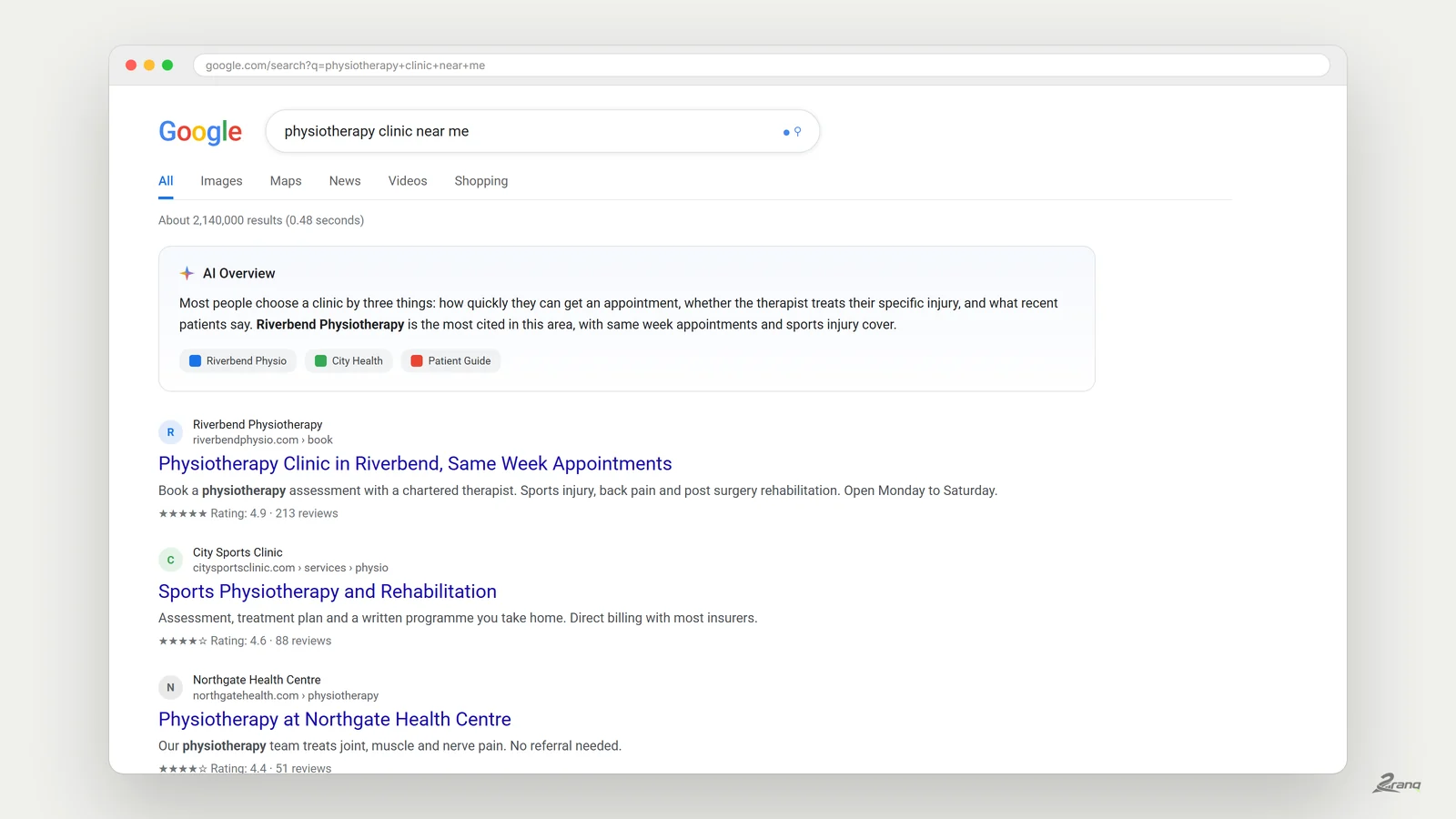
Ranking on Google is not luck, and it is not a trick. It is a system: the right keywords, a fast and clean site, content that answers real questions, and links that prove you are worth trusting. Here is how that system actually works in 2026, without the hype.
1) Start with buyer intent, not a pretty design
The most common mistake is starting with "make it look nice". Design matters. But it is not first. First comes the question: what does a customer type into Google when they want exactly your service?
Write a list of ten realistic searches. Not vanity terms like "best agency". Something concrete instead. For example: "business website design", "ecommerce website build", "SEO services", "Google Ads management". Those are searches with intent behind them. That is where the work comes from.
Then pick one main topic and five supporting topics. The main topic goes on your homepage and key service sections. The supporting topics go into your blog. That is how you build a system. And a system is what drives growth over time.
2) The technical foundation: no stable ranking without it
Google measures your site before it reads your content. If the site is slow, growth is slow. If the site is unstable, growth stops. Search engines will not push visitors toward a page that frustrates them.
These are the things that make a real difference:
- Fast loading, especially on mobile, where most traffic now lives.
- A clean sitemap and a correct robots.txt file.
- One canonical version of the domain (https, no duplicate http paths).
- Correct canonical tags so Google never sees duplicate pages.
- Core Web Vitals in the green, with no red warnings.
This is not a "nice to have". It is the base. When the base is solid, every new page you publish has a bigger effect. When the base is broken, you are writing into the void. If your current site is fighting you here, a rebuild on a clean, fast business website often pays for itself faster than another round of patches.
3) Site structure: Google has to understand you fast
A good website is like a well organized store. Everything is clear. No wandering. No "click ten times to find the price". A visitor sees what you offer right away, and how to contact you.
The minimum structure that works:
- Homepage: a clear offer, the benefits, a call to action.
- Services: short and specific, no jargon.
- Portfolio: proof of quality.
- Contact: phone, form, email, and location if you have one.
- Blog: content that captures searches.
The point is simple. Google likes clarity. And a customer likes it even more. When both get clarity, the results follow. Internal links matter here too: point your blog posts to the service they support, for example a piece on paid traffic linking to your Google Ads services, so Google understands how your pages relate.
4) SEO content: write answers, not "text"
A blog post is not decoration. It is a tool. If you write with no goal, you get nothing back. If you write as a direct answer to a specific question, you earn rankings and you earn inquiries.
A strong SEO article has:
- One clear primary topic.
- Descriptive H2 subheadings.
- Short paragraphs and short sentences.
- A concrete example from real work.
- A clear next step for the reader.
One thing changed sharply in 2026, and you should plan for it honestly. Google now shows AI Overviews on roughly 65% of searches, and the old FAQ rich result is effectively dead: those schema snippets no longer show as rich links for most sites. So do not chase gimmicks. Write content that is genuinely the best answer on the page, because the AI summary and the human reader are both scanning for exactly that.
How long does it take to rank a new website on Google?
For a brand new domain, expect three to six months before you see meaningful movement, and closer to six to twelve months for competitive terms. There is no way around it, and anyone promising the first page "in a week" is selling you something that does not exist.
A new domain has no history and no trust. Google needs time to crawl your pages, watch how people interact with them, and see other sites reference you. You speed this up with three things, and only three things: real content published consistently, a technically clean site, and honest links from places that already have authority. Everything else is noise.
The good news is that momentum compounds. The first few months feel slow because they are foundational. Once trust builds, each new page ranks faster than the last, because Google already trusts the domain it sits on.
5) Authority and trust: the signals that decide
Two sites can have similar text. Yet one ranks better. The difference is trust. Google wants evidence. People want reassurance. Both are looking for reasons to believe you.
What builds trust:
- A portfolio with concrete examples of real work.
- A clear statement of who you are and what you do.
- Contact details that make a visitor feel safe.
- A consistent design and tone of communication.
- A stable site with no errors.
Links from other reputable sites still carry a lot of weight, but quality beats quantity every time. One genuine mention from a respected site in your field does more than fifty low quality directory links. We work with clients across the US and Europe, which means we know the standards those markets expect. We raise the level with a system, not with talk.
6) Local SEO: the fastest path to first positions
If you run a local business, this is often the easiest win. People search "near me", and they search fast, ready to act. That is where inquiries are made.
What matters:
- A well maintained Google Business Profile.
- The correct category and an accurate service description.
- Photos, posts, and genuine reviews.
- Pages that actually make sense for each location you serve.
When this is done properly, results arrive faster than for broad, national keywords. It is also an excellent way for a new domain to build early momentum while your wider SEO gains traction.
7) Measurement and optimization: no serious growth without it
SEO is not "we did it once". SEO is a process. You measure, then you improve, and you keep doing that.
The basics are simple. Search Console shows what you appear for in search. Analytics shows how visitors behave once they land. When you have the data, you know what to strengthen and what to cut. If your traffic is growing but your sales are not, that gap is usually where the money is, and it is almost always fixable.
Done this way, blog posts stop being "content" and become a sales channel. Quietly, but reliably. For an online store, the same principle applies to product and category pages: a well structured ecommerce website turns search traffic into revenue instead of just visits.
How we do this at 2Ranq
We do not do "one article and done". We build a plan. The technical foundation. The structure. The content. And the ongoing optimization. Each part supports the others, which is the whole point of a system.
That is why we keep clear packages for different needs. From a website for a small business, through a full ecommerce solution, to a model built for teams that want continuous growth and support. If you want to understand where the real leverage sits, our SEO services page lays out the approach in plain terms.
If you want your site to genuinely rank higher, faster, and more securely, start with strategy. There are no shortcuts worth taking, but there is a right order to do things in, and that order is what separates sites that climb from sites that stall.
Quick recap (so the essentials stick)
- Choose keywords that bring buyers, not just visitors.
- Fix speed, stability, and the technical foundation first.
- Build a clear, logical site structure.
- Write content that answers real questions from real people.
- Build trust through proof, honest links, and transparency.
- Give a new domain time: months, not days, and stay consistent.
- Measure and optimize on a regular schedule.
Want your site to rank above the competition?
Let us start with strategy: a solid technical foundation, a clear structure, content that answers real questions, and regular measurement.