
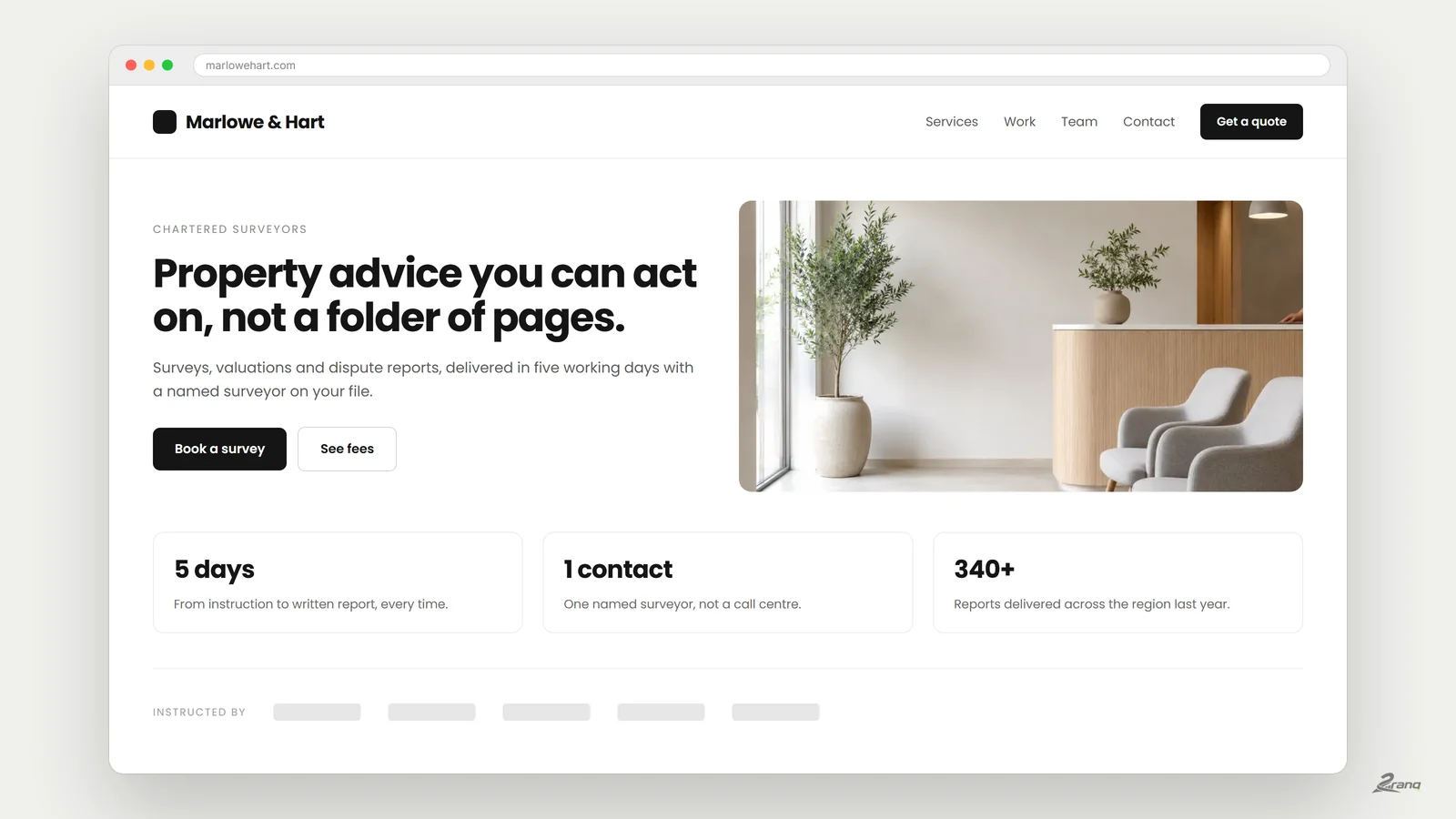
If your business has no website, you are almost certainly losing customers who are already ready to buy. People check Google first and call second. If Google has nowhere to send someone to see your services, your pricing range, your location, your photos and the overall impression you make, that person usually clicks the next result instead. In practice, that next result is a competitor down the road. This is why a website is no longer an "add-on." It is the foundation of your online presence and the strongest sales channel you have, working 24/7.
At 2Ranq we work with both US and European clients, so we know what actually converts in the real world. In competitive local markets, a clear offer and visible trust win the click. Across borders, speed, UX, structure and credibility decide who ranks and who gets ignored. Put those together and you get a website that looks serious, ranks better and brings in real leads.
Who needs a website the most (and why)
A website matters most for businesses where a client has to build trust before the first contact. These are services that carry a bigger decision, a higher price or greater responsibility. In those niches people do not rely only on Instagram or a map pin. They want to read the details, see examples, understand the process and feel safe before they reach out.
The biggest winners: clinics and medical practices, professional offices, service businesses competing for the same town, car rental companies, fitness centers, and anyone who wants a steady stream of inquiries instead of leaning on word of mouth.
A website "matters least" to businesses that are always fully booked and do not want to grow. Even then, a website helps you raise prices, filter out the wrong clients, cut down on repetitive questions and simply look more serious. It is often the difference between "people call to ask basic things" and "people reach out already decided."
How exactly do you lose clients without a website?
Without a website, the visitor never gets the full picture. They may see you on the map, but there is nowhere to check what you actually do and what makes you different. They may find you on social media, but that rarely has a clear structure, pricing, service breakdown or proof of trust. When someone is in buying mode, they want a fast answer. If they do not get it from you, they get it from the next business.
This is most visible in local search. In many cases Google favors the business with a clear website, solid information and stronger trust signals. If you are not there, Google effectively hands the job to your competitor.
The methodology: how a website that actually works gets built
A good website is not made by picking a template and "filling in the text." A good website is built through a process with logic and a goal. Skip the strategy and you get a pretty page that brings no inquiries. Skip the technical foundation and you get a site that loads slowly and ranks poorly. Skip the content and you get a site that never convinces anyone.
1) Strategy and goal: first we decide what "success" means
Before design, we ask one question: what do you want to happen when someone lands on the site? A phone call, a booking, a WhatsApp message, a filled-out form, or a purchase? Once the goal is clear, everything else lines up around it: the structure, the CTA buttons, the sections, the copy and the proof.
In parallel we define the target searches. Not the "biggest" ones, but the ones with real intent and a realistic chance to win. It is far easier, and far more profitable, to rank for a specific service plus a city than to chase broad terms that a new domain cannot realistically capture.
2) Site structure: order beats chaos
Structure means the visitor understands in 5 to 10 seconds who you are, what you offer and how to contact you. A good website never forces people to "explore." It guides them.
The basic structure that works for roughly 90% of service businesses:
- Home (offer plus benefits plus proof plus CTA)
- Services (clearly explained, without walls of text)
- Portfolio and case studies (if you have them)
- Contact (simple and visible)
- Blog (for growth through Google)
When the structure is clean, Google understands the topic of the site more easily, and the visitor decides faster.
3) Content that sells and ranks: concrete, no filler
Content is where people decide. Not just Google. People. Good content answers the questions the buyer already has in their head: what exactly do I get, how long does it take, what is included, who is it for, and why should I trust you specifically.
That is why at 2Ranq we write copy that is clear and human. The sentences read naturally, they are not chopped into robotic fragments. We give context, explanation and proof, because that is what sells. At the same time, the content is structured so Google understands the topic through natural headings, logical sections and relevant terms.
4) Design and UX: trust is built in the details
People judge how serious you are in seconds. Design plays a role here, but not through "fancy" effects. It works through a sense of order, cleanliness and professionalism. Clear typography, consistent spacing, a strong heading hierarchy, quality photography and a logical section flow all decide whether someone takes you seriously.
For many fields (medical practices, law firms, accountants, financial advisors) UX and trust elements are decisive. It is not the same as selling a t-shirt. Here you are selling peace of mind.
5) Technical foundation and speed: Google measures first, then ranks
Speed and stability are no longer "nice to have," especially on mobile. If the site loads slowly, the visitor leaves. When they leave, Google reads a bad signal. That directly affects both ranking and conversion.
So it matters to:
- optimize images and scripts
- run stable hosting with proper caching
- avoid unnecessary plugins
- fix Core Web Vitals
- keep one version of the domain (https, no duplicates)
6) SEO built in from day one: so the site can grow
SEO is not just "drop in a keyword." SEO is structure and consistency. That means proper titles, meaningful URLs, clean metadata, internal linking between pages and a real plan for content.
For a new domain especially, the SEO foundation is critical, because you want every future post and every new landing page to have somewhere to anchor. This is exactly where pillar pages and cluster pages do their best work.
7) Analytics and optimization: no measurement, no real progress
Once the site goes live, you do not just walk away. You set up measurement, track inquiries, watch which searches bring traffic, and keep optimizing. That is the difference between "we have a website" and "our website brings us clients."
Hidden costs and "downsides" people often miss
The biggest mistake is treating a website as one price and nothing more. In reality there are real line items to plan for:
- domain and hosting (both renew)
- business email and DNS setup (so your mail does not land in spam)
- maintenance and security updates
- premium add-ons (when specific features require them)
- content and photography (because without it there is no trust)
- legal pages (privacy policy, cookies, terms)
When this is explained upfront, there are no surprises. When it is left unsaid, the client later feels "ripped off," even though they were not. They simply were not told.
Website development by industry: niches that gain the most
Below are examples of niches where targeted landing pages deliver results, because the searches are specific and the visitors arrive with clear intent:
- Websites for dentists: everything a practice needs, online booking, pricing and services, reviews, before-and-after galleries, local SEO and the Google Business Profile.
- Websites for law firms: professional presentation, practice areas, trust built through content and case results, a clear intake form and strong local visibility.
- Websites for auto detailing: work galleries, service packages, before-and-after shots, appointment booking and easy contact from mobile.
- Websites for physical therapists: services and treatments, scheduling, frequently asked questions, reviews and local ranking.
- Websites for pet groomers: pricing and packages, gallery, appointment booking, location and proof of quality through photos.
- Websites for accountants: clearly explained packages, consultations, an inquiry form, trust through experience and content that explains the service.
- Websites for notaries: clear information, required documents and procedure, hours, location, fast communication and a professional impression.
- Websites for car rental: vehicle catalog, terms, deposit, contact, a reservation form and SEO for local searches.
- Websites for gyms and studios: schedules, memberships, training programs, gallery, Google profile and a quick way to send an inquiry or book a trial session.
This is the logic behind why a landing page per niche works: the visitor sees exactly what they searched for, without scrolling through generic content.
How do you know a website is actually "good"?
There is a simple test. When someone lands on the site for the first time, is it obvious what you offer and for whom, why you are the right choice, and how to contact you without thinking twice? If the answer is yes, the site has a real shot at selling. If the answer is no, you have a design without a strategy.
Conclusion: a website is an investment that pays back, but only when it is done right
A website is not just an "online business card." It is a sales system. It should look serious, load fast, build trust and be structured so Google can understand it. When it is built to a methodology, the website becomes your best salesperson, working 24/7, generating inquiries and raising the level of your business, whether you serve one city or several markets.
If you want growth, start from the foundation. Structure, content, speed and trust. That is what separates a website that merely "exists" from one that actually brings you clients.
Want a website that brings you clients?
Let's start with strategy. You get the plan and the quote before you pay anything, and we build the site to a methodology that actually sells.